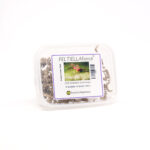
Spider Mite Predatory Midge Feltiella acarisuga

Page Intro: Feltiella acarisuga is a predatory midge used for the control and management of various spider mite species. On this page you will find a description, life-cycle info, benefits, drawbacks, scouting info, advisories, usages, and other good stuff such as ordering.

Description

Pupation Previously known as Therodiplosis persicae, F. acarisuga are tiny ~2mm light-brown to tan with a pink hue, mosquito-like midges in adult form. Their larvae, which are yellowish and worm-like, prey on spider mites species from the genus Tetranychus, but they seem to have a preference for the two-spotted mite, Tetranychus urticae. And this is a good thing as T. urticae is the number one mite pest.

Unlike most spider mite predators, F. acarisuga can fly from location to location. As nomadic creatures, this is how they perform their job — flying from mite colony to mite colony, laying eggs on the run so to speak. This can be a huge benefit for growers who have taller or wide-spread planting.

Feltiella acarisuga — which are really just a type of fly from the order Diptera — and other related species, can be found in nearly all corners of the world so it is reasonable to expect a little bit of establishment from these predators, but as in the case of all biocontrols, a lot of this will depend on the availability of food, shelter, and the other of life’s little necessities. These midges haven’t been commercially available for long, but they have a long natural track record and should prove valuable on commercial levels. It should be noted, though, that adoption has been slow at best so we lack practical feedback. [Intro]

Life-style

F. acarisuga are similar to the aphid predatory midge Aphidoletes aphidimyza, but they spend all their time on the plant and do not drop to the ground like the aphid midge. F. acarisuga are supplied as off-white pupal cocoons that soon emerge as adults. The adults feed, mate, and fly to a colony of mites to begin oviposition or egg-laying. From that point, predatory behavior begins in about fifteen days, depending on environmental conditions.

The life span, from egg-stage to egg-stage requires nearly a month on average. Post hatch, the larvae feed for up to a week then pupate. The conditions for optimum performance will be between 66-70°F with a relative humidity of around 90%. But these are optimum conditions and not necessarily a prerequisite of successful implementation. Please note, however, as noted, significantly cooler or warmer temperatures and humidity fluctuations may hamper reproduction and development a certain degree. [Intro]

Benefits

As mentioned, F. acarisuga can fly — they are flies after all — so they may be useful in difficult to reach areas and taller planting to take care of the otherwise out-of-reach pests. Another benefit to using these midges is that the larvae can survive for several days in the absence of prey. Therefore they can be used in onset preventive and low-infestation management situations.

F. acarisuga larvae are no lightweights. If they get a toe-hold in a situation and make themselves at home, they can devour an incredible number of mites. Up to five times the number consumed by Phytoseiulus persimilis.

Drawbacks

Cocoons They’re somewhat on the expensive side which certainly makes them a drawback. If, however, they prove their value over time then a higher price point is arguably justifiable. Another potential drawback to using F. acarisuga is that they do have a fairly limited environmental range in which they will perform best. This, in one regard, makes their use somewhat limited. On the other hand, though, they will be happy in many typical situations. Tomato tunnel houses, sub-tropical and tropical arboretums and botanical gardens. Add to this the entire state of Florida and you’ll realize there are prime opportunities for their use.

F. acarisuga are only predatory as larvae. The adult forms don’t eat mites themselves. Because of this, users need to allow time for establishment. Positive results will likely not result from introductions made in areas with higher pest populations. That would be a better job for one of the other mite predators discussed in this section. [Intro]

Scouting

Users should note what the pupae or cocoons look like when they receive these midges. This will make finding the pupae easier when the time comes. Scouts should look for the cocoons along the underside mid-rib of leaves. I addition to this clear sign of activity, scouts should also look for reduced pest numbers and the presence of adults on the leaves or in flight — though the latter is really sort of a rarity except on overcast days. Another sign of activity would of course be from the larval forms in the midst of spider mite colonies — look in the webbing — but this can be difficult as the larvae are small. Even smaller are the clear-white eggs, so trying to find them may make a scout crazier rather than more successful. [Intro]

Advisories

A relative humidity of at least 50% needs to be maintained. Furthermore, temperatures must not exceed 86°F, else development of the larvae will come to a virtual stand-still. This is a fairly narrow range, but it is attainable in most controlled environments (or naturally in the deep south). There is an oviposition stimulant that normally ships with F. acarisuga (ask to make sure your supplier provides this). It is quite important that this be used to initially establish these midges. They can and do work without it, but it greatly enhances their use so it’s highly recommended.

The mite midges get along great with other mite predators, but due to population dynamics, once F. acarisuga midges are established in a given location, it is best to not introduce other aggressive predators like P. persimilis. Doing so will upset the balance and you’ll more than likely decimate your midge numbers. [Intro]

Usages

Greenhouses, interiorscapes, everywhere just about. Outdoors, too, would be fine, but if it’s a really windy area they may be blown away too much to be truly effective. As noted on this page, you must be sure you can provide the right conditions for these predators. Please note, however, that normal fluctuations caused by the sun’s location in the sky — or lack thereof — is perfectly normal and acceptable. Look at the median temperatures. Do be sure the humidity is consistently on the high-side, though. [Intro]

Rates, Instructions, and Purchase

Need more information? Check out our release rates or our short-term storage, handling, and release instructions. You may also purchase F. acarisuga. [Intro]


Glossary | Top


Note: This is the end of the usable page. The images below are preloaded for performance only.