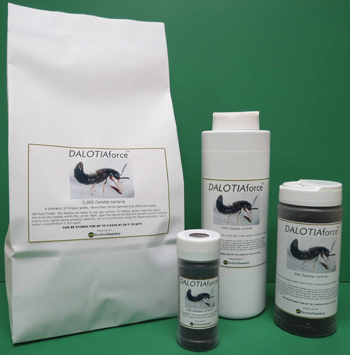
Page Intro: Atheta coriaria, also known as the Rove Beetle, is used for the control and management of various soil pests. On this page you will find a description, life-cycle info, benefits, drawbacks, scouting info, advisories, usages, beyond the page, and other good stuff such as ordering.
Description
This species is described as 3-4 mm., flight-capable, soil-dwelling predatory beetles which feed on several species of fungus gnat larvae (Lycoriella, Sciara, Bradysia spp. and Mycetophilidae family members), thrips pupae (species like Frankliniella occidentalis also known as Western flower thrips, F. tritici a.k.a. flower thrips, and others which drop to the substrate to pupate), springtails (Collembola family members), shore fly larvae (Ephydridae family), moth fly larvae (Psychodidae family), perhaps even March fly larvae (Bibionidae family).
They may also provide control of root mealybugs, species like Rhizoecus arabicus and others belonging to the family Pseudococcidae. And the ever-popular “more.” I don’t write that casually either. Rove beetles, due to the way the can get around, (remember, flight-capable), may consume pests such as aphids and mites. I would not, however, bet the farm on that one (no pun). If you have aphids and mites, use aphid and/or mite biocontrols. Do explore A. coriaria’s uses, though, as the range of their uses is yet to be determined.
These are beetles, yes, but they don’t look like beetles. They are long and narrow and simply do not look beetle-like. The have short, indistinct eletra or wing covers. It’s difficult to see them fly so when you do see them they are typically seen sort of snaking along the ground. They can also be seen, especially when disturbed, with their abdomens curved upward, like a scorpion. Really weird, but hey, this is no beauty contest. Rove beetles are tough little buggers. [Intro]
Life-style
A. coriaria dwell primarily in the substrate as told, and they fly. Put the two together and make note that these beetles can rapidly colonize a release area. The sex ratio is 1:1 so everybody’s happy. The eggs take 3-4 days to hatch into predacious larvae, which look somewhat simliar to the adults. They pupate in silken chambers. Altogether they live for about 21 days at 70°F. The conditions for optimum performance will be between 67-78°F with a relative humidity of around 40-99%. But these are optimum conditions and not necessarily a prerequisite of successful implementation. Please note, however, significantly cooler or warmer temperatures, and especially drought, may hamper reproduction and development a certain degree. [Intro]
Benefits
They have a wide range of dietary options at their disposal and can quickly react to differing pests without much of a problem. Due to their ability to colonize rapidly, react is an apt word. Their populations should mirror those of their prey after established. Being opportunistic, their numbers may stay fairly high in an area such as a greenhouse with a gravel floor or raised beds, or a garden with lots of organic matter. This is definitely a good thing as it may allow for more infrequent releases. More time and usage will generate more information.
They are readily available. That’s always a good thing.
They don’t undergo diapause and thus can be used year ’round if the conditions allow it. [Intro]
Drawbacks
Not sure yet, exactly. They are a little slow-acting when initially released. They seem to need a period of doing their reproductive thing before spreading out and doing their eating thing. They don’t provide a huge bang for the buck, the results of their use is subtle. At first. It does seem that once they have been in place a bit and released a few times they begin to act like the bugs I described under Benefits, above.
They don’t care too much for pesticides, but can handle Bt products and such. Foliar sprays are best if you must spray. Soil-applied chemicals are potentially more harmful. As I wrote above, more time and usage will generate more information.
They are not cheap. But in the long run, I think they represent a good economy. A lot, then, depends on the crop, environmental conditions, their ability to find food and make ends meet. [Intro]
Scouting
From what I have been told by growers in the field is that the rove beetle is not that easy to scout. With clustered colonies, though, and due to the fact they’ve been used mostly in really large greenhouses (the largest reporting source), it’s really not too surprising. You almost have to stumble upon them. If you do, they will scurry around, “tails” raised, trying to get away from you. They may fly at that point. They are not easily actually seen in flight. We still need to learn more.
We’ve had no reports of catching them on sticky traps. Still, though, keep a sharp eye for that sort of thing. If you have a lot of airborne rove beetles, you may be disturbing their home too much somehow. [Intro]
Advisories
Try putting flat rocks on the ground in places throughout the greenhouse, garden or growing area. This will serve two purposes. One, the rocks will provide shelter for them from the sun and retain moisture (provided it gets water) for longer periods. Second, you can lift a few rocks during your scouting to confirm their existence. [Intro]
Usages
Greenhouses, gardens, interiorscapes, anywhere there is shelter, food, and the right conditions. I say “try them!” but, then, would you really expect anything else from me? [Intro]
Rates, Instructions, and Purchase
Need more information? Check out our release rates or our short-term storage, handling, and release instructions. You may also purchase A. coriaria. [Intro]