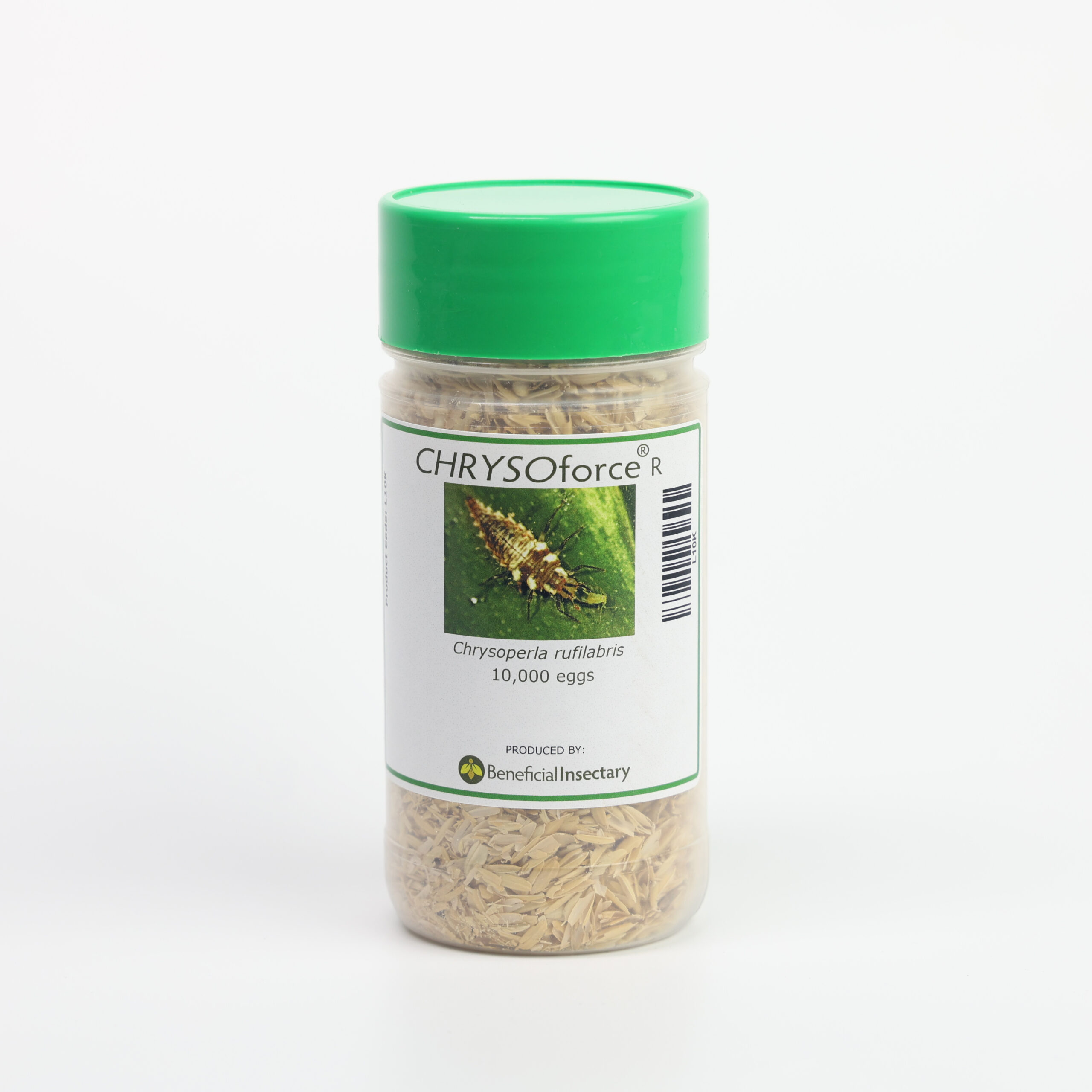
CHRYSOforce™ R – lacewing eggs in loose form (5,000/ 10,000/ 100,000)

Price range: $24.95 through $399.95 or subscribe to save 5%

Buy 5 or more bottles of 5,000 for $18.10 each!
Buy 5 or more bottles of 10,000 for $31.60 each!
(discount will be applied in your cart)

Order by Friday at 4PM PST to receive the following week.

Product Description

Green Lacewing Eggs for Natural Aphid Control

CHRYSOforce™ R – 5,000 Green Lacewing Eggs on Card offers a powerful, chemical-free way to defend your plants from aphids and other soft-bodied pests. These beneficial insects begin working shortly after hatching, creating a fast, reliable, and sustainable pest control solution.

Why Choose Green Lacewing Eggs?

If you’re looking for a natural way to stop aphid outbreaks, green lacewing eggs are an ideal first line of defense. Once hatched, the larvae—also known as “aphid lions”—immediately begin feeding on pests such as:

  • Aphids

  • Thrips

  • Mealybugs

  • Spider mites

  • Whitefly eggs and nymphs

Rather than waiting for a problem to grow, you can proactively release lacewing eggs to establish ongoing protection. Female lacewings lay hundreds of eggs near pest hot spots, which helps maintain control long after the initial release.

How It Works

Each card contains at least 5,000 viable green lacewing eggs, evenly distributed across 30 perforated sections. Simply tear and hang each piece near pest pressure zones. When temperatures stay near 80°F, the eggs hatch in 2 to 3 days. From there, the larvae actively search out and consume soft-bodied pests, often devouring up to 50 aphids per day.

Because these insects are constantly hunting, they help reduce infestations quickly and efficiently—without chemicals.

Application Instructions

To use, hang card pieces in shaded areas close to the infestation. Avoid placing them in direct sunlight or near ants, as ants may interfere with larvae. Eggs typically hatch within 48 hours and the larvae begin feeding immediately.

For best results:

  • Release during early morning or late afternoon

  • Reapply every 2–3 weeks during peak pest seasons

  • Store cards at room temperature and avoid refrigeration

  • Monitor plant health regularly

If pest pressure is high, increasing frequency or combining with other biocontrols may improve performance.

Long-Term Protection, Naturally

Unlike synthetic sprays that wear off quickly, lacewing eggs support a more sustainable pest management strategy. As adults mature, they continue laying eggs around your plants—extending the benefits and reducing your need to intervene.

This natural cycle supports Integrated Pest Management (IPM) systems and helps maintain healthy plant environments across:

  • Greenhouses

  • Gardens

  • Indoor grows

  • Vegetable beds

  • Cannabis and ornamentals

Protect Your Plants Without Pesticides

If you want to safeguard your crops while avoiding harmful chemicals, green lacewing eggs are a smart, eco-friendly solution. Backed by decades of use in agriculture and home gardens, these eggs offer both preventative and responsive pest control.

Choose CHRYSOforce™ R and bring nature’s pest control into your growing environment—because your plants deserve the best defense.


Back to CHRYSOforce™ R…

Release Rates for Chrysoperla rufilabris

ClassificationRelease Information
Prevent1-3 per 10sq.ft., monthly, as needed
Low2-5 per 10sq.ft. bi-weekly, 2-3 times
Med4-8 per 10sq.ft., weekly, 2-4 times
High1 per sq.ft., bi-wkly, 3-5 times
Maint1-2 per 10sq.ft., tri-weekly, indef.
Garden60-90% of rates listed
Acre+20-50% of rates listed.
CommentsRates shown are for larvae. If you’re using eggs, multiply the calculated rate by five (5). If employing adults, divide the calculated rate by four (4).

Release rate suggestions on these pages are usually not sufficient for cannabis growers. For cannabis release rates contact us: 1.855.289.1441 or [email protected].

Release instructions for the Release And Use Of Green Lacewing Eggs

This species of adult lacewings do not kill other insects but instead feed on nectar, honeydew and pollen. Adults lay and distribute their eggs on plants. The eggs hatch into larvae (the juvenile forms), which do feed on pests and provide control. Larvae are similar in appearance to tiny alligators having pinch-like ice tongs that are the mouth parts. The larvae vigorously attack aphids and other prey by first injecting paralyzing venom and then drawing out the body fluids, leaving only a dead, dried up shell of the pest. Each larva can devour up to 200 victims a week.

Lacewing larvae feed on a wide variety of soft-bodied pests including aphids, mealy bugs, cottony cushion scales, mites, thrips, leafhoppers, small caterpillars and the eggs of many insect pests. After about two weeks of feeding, the larva pupates after enclosing itself in a cocoon of silken thread. The pupa is a resting form that develops into the adult, a process requiring from five to eight days. The adult then emerges from the cocoon, mates, and proceeds to lay hundreds of eggs over a 3 to 4 week period. The eggs are laid near insect pests. Each egg is mounted at the top of a hair-like filament or stalk attached to the foliage. The eggs hatch in three or four days. Newly hatched larvae are tiny and difficult to observe.

Release eggs when several newly hatched larvae are seen moving in the container. Eggs may be hatching upon arrival. We recommend the following four criteria as the best means to determine that eggs are ready for immediate field release:
1. Egg membranes are dull gray.
2. Abdominal bands of larvae are distinct.
3. Larval eyespots are readily visible.
4. At least 1% of the eggs have hatched. Release as specified above to minimize cannibalism.

Lacewing eggs are normally shipped in a container with rice hulls. This combination provides separation of eggs and enhances their distribution to places where pest infestation occurs. To release the eggs, simply sprinkle the contents of the container over the targeted plants. But go easy; don’t sprinkle the complete contents in one spot. For better coverage, mix the eggs in a larger container with an additional carrier. Any carrier can be used that does not harm the eggs or larvae yet aids in distribution. Such carriers include wheat bran, vermiculite, fine saw dust etc. If the pest problem is persistent, you may want to apply lacewing eggs at pre-planned intervals.

We do not recommend storage. However, in case of inclement weather or logistical problems, egg hatch can be delayed for 1 – 2 days by cool temperature incubation. Eggs should be cooled only on the day of receipt and held at 50º to 60º F and 50% - 75% relative humidity. Cooling older or welldeveloped eggs may lower the hatch rate. Warmer temperatures will speed up their emergence, but the eggs should not be held at more than 80 degrees F.
ISSUES TO BE AWARE OF:

The larvae that will be emerging are very tiny and hard to see. If the larvae are not released immediately upon hatch, they will cannibalize each other. If you are not able to monitor for hatch, it is best to release eggs immediately upon receipt.
IMPORTANT:

Report any and all suspected problems such as dead or less-than-healthy organisms within 24 hours after receipt of shipment.
Do not, under any circumstances, release or discard suspect organisms until you have received instructions to do so.

You may be asked to return the shipment for further analysis.

Thank you for your order.
Overnight shipping required.
Order by Friday 4PM PST to receive the following week.
Will ship Tuesday's and Wednesday's
This product is affected by US holidays.

You may also like…